
Key Takeaways
- For HDB households, choose an aircon system based on your flat size, how many rooms you want to cool, your usage habits, and your DB capacity.
- Remember that Climate Vouchers can only be used to purchase air-conditioners with a 5-tick energy rating.
- Choose air-conditioners with a 5-tick energy rating and inverter technology to reduce electricity consumption and lower your energy bills.
- Choose an aircon with a suitable cooling capacity, measured in British Thermal Units (BTU), based on each room’s size. A unit with insufficient BTU may struggle to cool the room, while one that’s too powerful may waste energy.
Picking an air-conditioner may not seem like a decision that requires much thought, but it’s one of the bigger purchases you’ll make as a new homeowner, especially during your home renovation.
Choose the wrong system, and you could be stuck with insufficient cooling, a noisy condenser, or unnecessarily high electricity bills for years to come!
But finding the best air conditioner in Singapore isn’t exactly a walk in the park. Every brand claims to offer the quietest, most energy-efficient models, and the best cooling capacity. With so many options to compare, it can be tricky to know which aircon is actually worth your money.
To help you out, we compared several aircon systems from major brands to help you find the best air conditioner for your new home.
At a Glance: Best Aircons in Singapore
Setting up the rest of your home too? Check out our guides on choosing the best broadband plans, water dispensers, and robot vacuums.
Here are our top picks for the best aircons in Singapore, by category.
| Category | Model | Price | Warranty |
| Best overall | Mitsubishi Electric Starmex | S$3,674 | 5-year compressor, 1-year fan coil |
| Best for energy efficiency | Daikin iSmile Eco+ | S$3,430 | 5-year compressor, 1-year parts |
| Best budget | Hisense / Hitachi FrostWash | S$3,205 / S$3,314 | Check with retailer |
| Best for allergies | Panasonic XU Series | S$3,475 | Standard 1-year |
| Best portable | Midea MPPD-11CRN7-A | S$489 | 1-year general, 3-year compressor |
All prices are based on Courts’ listed prices at the time of publishing and exclude installation.
Split-system prices are for a System 3 (3 × 9,000 BTU), excluding installation. Yearly energy use and cost are the NEA energy label estimates shown on each retailer’s listing. Your bill will depend on how much you run the unit, the temperature you set, and your electricity plan.
#1 Best Overall: Mitsubishi Electric Starmex
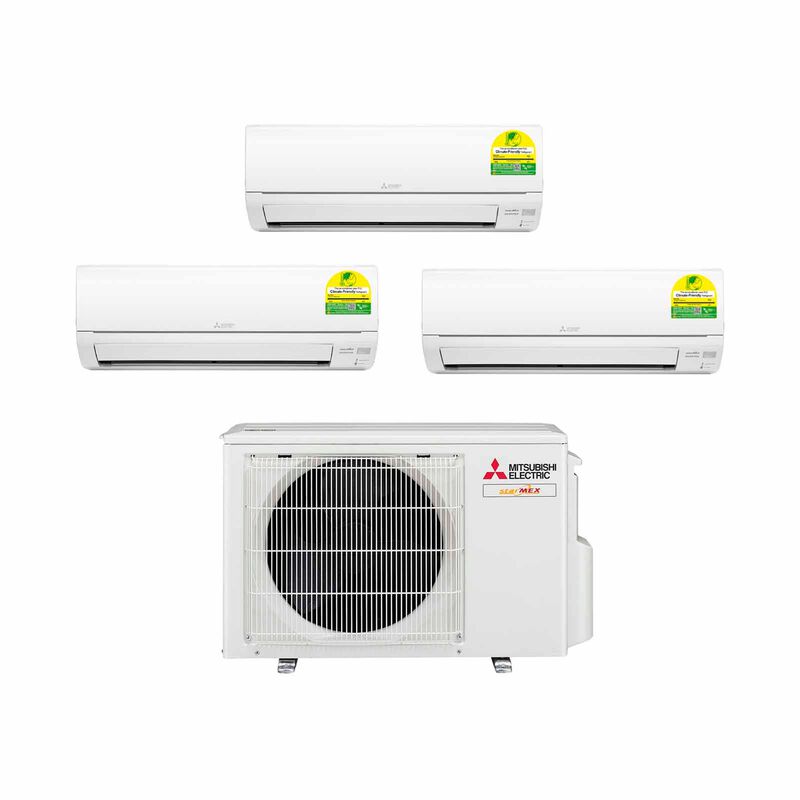
The Mitsubishi Electric Starmex System 3 aircon (MXY-3H28VG 28K condenser + MSXY-FP10VG) strikes the right balance. It’s a 5-tick inverter aircon, uses R32 refrigerant to reduce energy consumption and environmental impact, and has a silent mode as low as 19 dB, which is barely audible.
The dual-barrier coating is a two-layer treatment on the heat exchanger, fan, and ducts. It stops dust and oily grime from sticking, so the unit stays cleaner and keeps running efficiently.
At S$3,674, the Mitsubishi aircon is the most expensive of our System 3 picks, but it comes with a 5-year compressor warranty. According to its listing on Courts, the yearly usage is 2,418 kWh, or about S$653.
Best for: households that want a quiet, efficient System 3 aircon and don’t mind paying a little more.
#2 Best for Energy Efficiency: Daikin iSmile Eco+
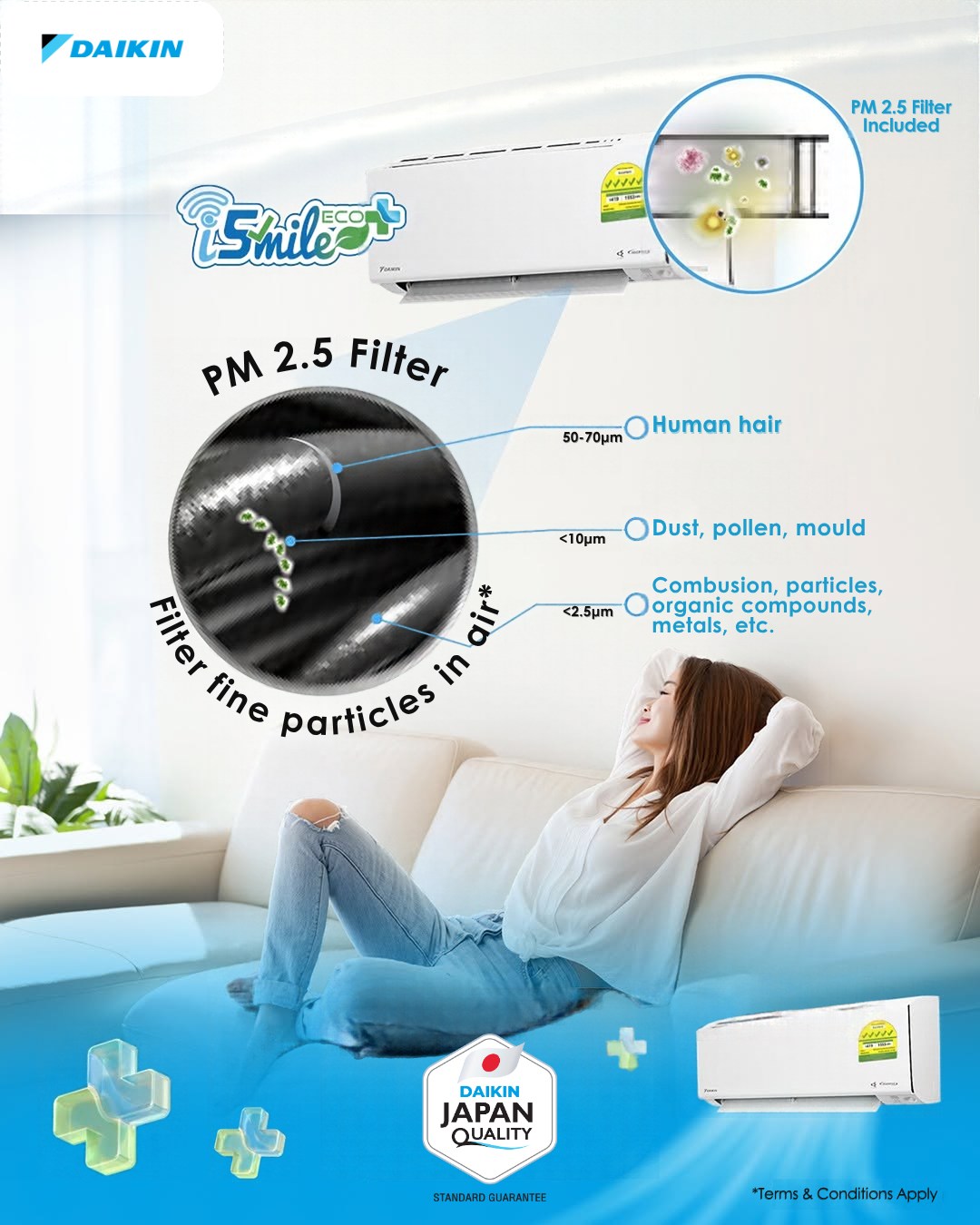
The Daikin iSmile Eco+ is the energy-efficient aircon to beat, with a 5kWh condenser (as listed by Courts) and three 9,000 BTU fan coils. This 5-tick set has a yearly running cost of about S$401 on its NEA energy label, based on 1,483 kWh.
It also has Daikin’s Streamer technology, which releases high-speed electrons that react with the oxygen and nitrogen in the air to break down odours, bacteria, and mould. Its mould-proof operation mode keeps the fan running for up to an hour after cooling, drying the inside of the unit so mould has less chance to grow.
The Daikin aircon price is S$3,430, lower than the Mitsubishi’s S$3,674, with a 5-year compressor warranty.
Best for: households that run the aircon for long hours and want to keep bills down.
#3 Best Budget: Hisense and Hitachi FrostWash
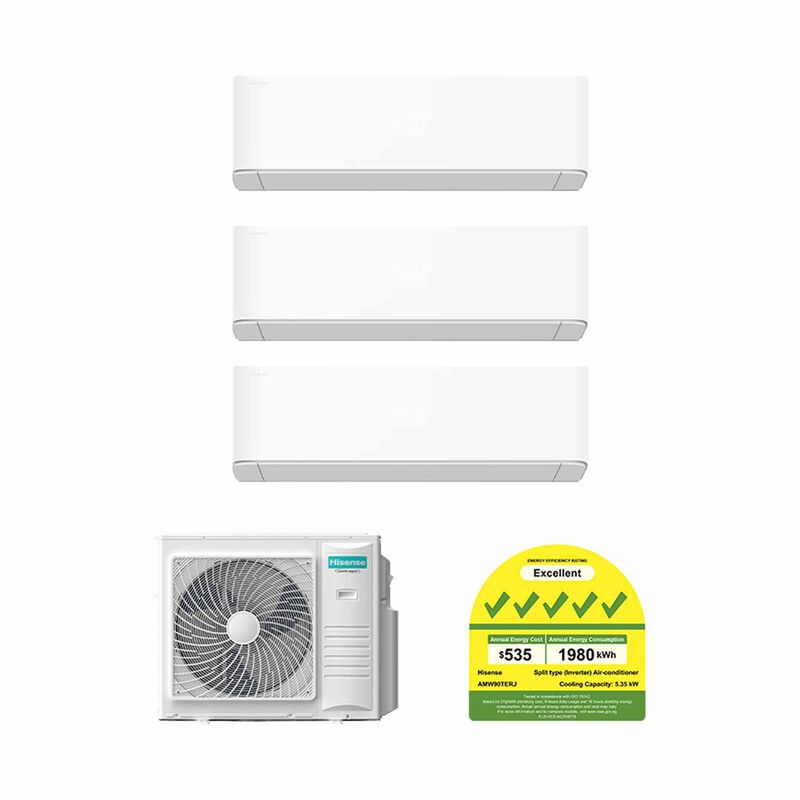
If you’re looking for the cheapest aircon in Singapore with 5 ticks, the Hisense System 3 (model AMW70TERJ condenser + AMS-09TWERUHA00) and Hitachi FrostWash System 3 (model RAM-Z30C3MS condenser + RAK-ZJ10CMS) are worth considering.
The Hisense System 3 costs S$3,205, plus three 9,000 BTU fan coils. What’s great about the Hisense is that its anti-mildew treatment helps stop mould from growing inside the unit, and its 4-in-1 filter combines layers to trap dust and reduce odours. It also has an AI Smart mode, which Hisense says adjusts the temperature, humidity, airflow direction, and fan speed automatically at the press of one button. The product details mention yearly usage of 1,524 kWh.
Meanwhile, the Hitachi FrostWash System 3 costs S$3,314, with a 30K condenser and three 9,000 BTU fan coils. Its FrostWash function freezes the moisture on the indoor coil to trap dust, mould, and bacteria in a layer of frost, then melts it away through the drain. It also has a PM2.5 filter, which catches particles 2.5 micrometres or smaller. Its label puts yearly use at 2,394 kWh.
Best for: new homeowners who want 5-tick efficiency at the lowest upfront price.
#4 Best for Allergies: Panasonic XU Series With nanoe X
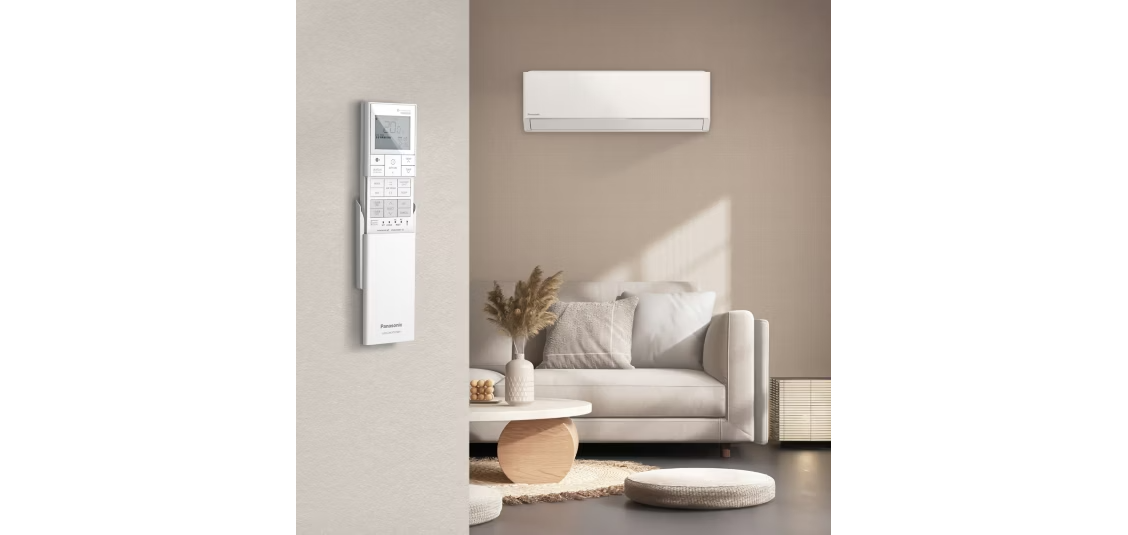
The Panasonic XU Series (CU-3XU28YBZ 28K condenser with three CS-XU9BKZW fan coils) runs Panasonic’s nanoe X Generator Mark 3, which releases nanoe X, a mist of charged water particles.
Panasonic says these inhibit bacteria, viruses, and pollen, and you can run it 24 hours a day, even with cooling off. An inside-cleaning function also dries the unit to prevent moisture buildup.
It’s 5-tick, comes with built-in Wi-Fi, and costs S$3,475. The listing shows a standard 1-year warranty.
Best for: families with allergies or anyone who wants cleaner bedroom air.
#5 Best Portable Aircon in Singapore: Midea and EuropAce
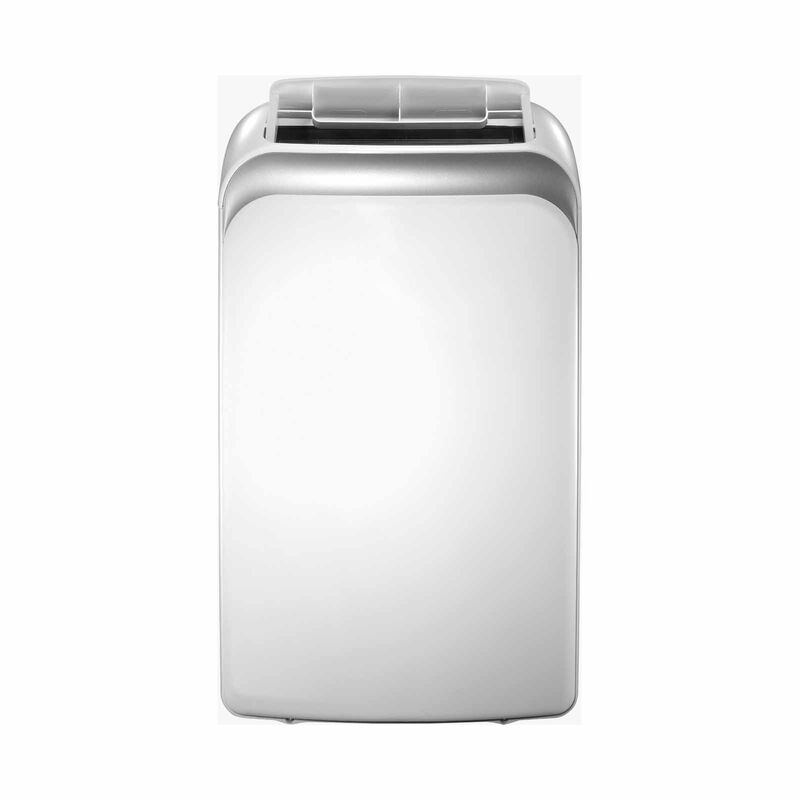
For renters, or rooms without a fan coil, a portable aircon can be a practical alternative.
The Midea MPPD-11CRN7-A is worth considering. It offers 11,000 BTU of cooling capacity, costs S$489, and comes with a 3-year compressor warranty.
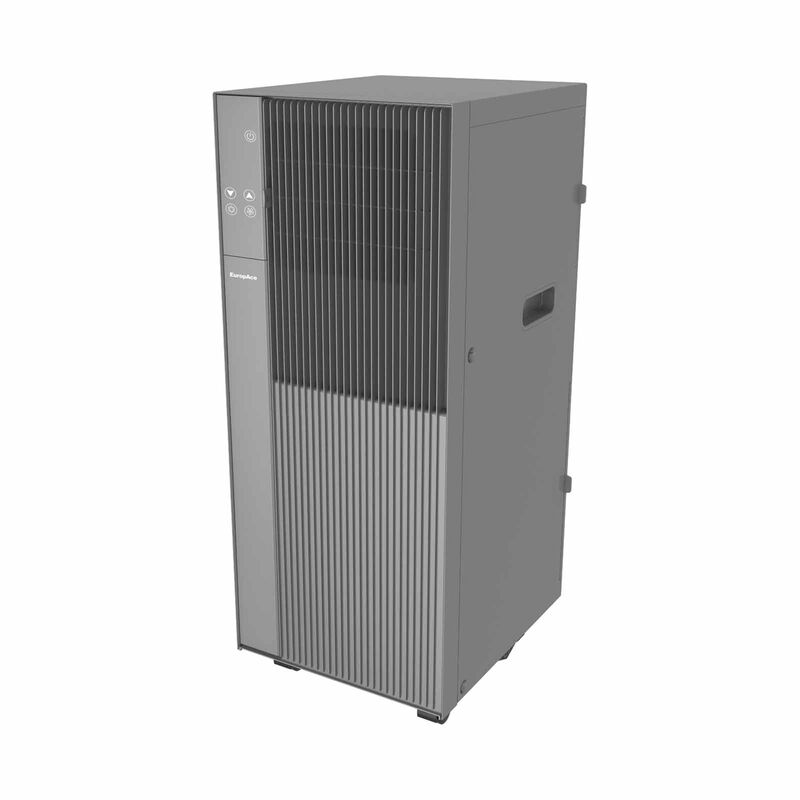
Another option is the EuropAce EGAC12D7F. Priced at S$699, it has a higher cooling capacity of 12,000 BTU and dual filtration to capture dust and other particles.
However, portable air-conditioners consume more energy than split-system units. Also, Climate Vouchers can only be used for air-conditioners with a 5-tick rating, so neither the Midea nor the EuropAce model qualifies, as both have a 1-tick energy rating.
Ultimately, portable aircons are better treated as a temporary cooling solution rather than a long-term replacement for a split system.
Best for: tenants and short-term setups during renovation.
System 1, 2, 3, or 4 Aircon: Which Do You Need?
When choosing an air conditioner for your home, you’ll likely come across terms such as System 1, 2, 3, or 4.
These numbers refer to how many indoor aircon units (fan coils) connect to one outdoor compressor unit, also known as a condenser.
For example, a System 4 setup means four indoor air-conditioner units are powered by one outdoor compressor, allowing you to cool four rooms.
For most HDB households, the right system depends on your flat size, how many rooms you intend to cool, your usage habits, and electrical distribution board (DB) capacity.
| Aircon system | Number of indoor units | Rooms |
| System 1 | 1 | A single bedroom or the living room |
| System 2 | 2 | Two bedrooms or a bedroom and living room |
| System 3 | 3 | Three bedrooms or two bedrooms and a living room |
| System 4 | 4 | Three bedrooms and a living room |
However, more indoor units don’t necessarily mean better cooling. All indoor units share the outdoor unit’s cooling capacity. If several rooms are running aircon at the same time, an undersized outdoor unit may struggle to cool them effectively.
Renovation tip: Decide on your aircon system before starting carpentry work. Installing the piping and trunking early makes it easier to conceal them and avoid unnecessary changes later.
Aircon Price in Singapore: How Much to Budget
Aircon prices in Singapore depend on the system size, the BTU of each fan coil, and the brand. The following is based on Courts’ listed prices at the time of publishing.
| System | Example | Listed price |
| System 2 | Mitsubishi Electric Starmex (2 × 12,000 BTU) | S$2,669 |
| System 3 | Our five picks (3 × 9,000 BTU) | S$3,205 to S$3,674 |
| System 4 | Mitsubishi Electric Starmex (3 × 9,000 + 18,000 BTU) | S$5,359 |
As a quick guide, System 2 aircon prices start under S$3,000, System 3 aircon prices run about S$3,200 to S$3,700, and System 4 aircon prices can exceed S$5,000.
Note that these prices exclude installation. Your aircon installation cost in Singapore will depend on piping length, trunking, condenser brackets, and whether old units need removing.
Factors to Consider When Choosing an Air-Conditioner for Your Home
Besides the aircon system, there are a few other factors to consider when buying an aircon for your home:
#1. Cooling Capacity
An aircon’s cooling capacity is measured in British Thermal Units (BTU). The higher the BTU rating, the more heat the aircon can remove from a room.
An aircon with too little cooling capacity may struggle to cool your room, while an oversized unit can waste electricity and may not remove humidity effectively.
Here’s a rough guide:
| Room type | Recommended cooling capacity |
| Small bedroom | 9,000 BTU |
| Medium to large bedroom | 9,000 to 12,000 BTU |
| Living room | 12,000 to 18,000 BTU |
For multi-split systems (systems 2, 3, or 4), remember that all indoor units share the outdoor unit’s cooling capacity. This means the outdoor unit must be powerful enough to support the rooms you want to cool at the same time.
For example, a System 4 aircon might have three 9,000 BTU indoor units and one 18,000 BTU unit, giving a combined capacity of 45,000 BTU.
However, if the outdoor unit has a rated cooling capacity of 38,000 BTU, it may not meet the combined demand if you turn on all four indoor units. As a result, some rooms could take longer to cool or struggle to reach the set temperature.
The key is to consider which rooms you’ll use at the same time, rather than simply adding up the BTU ratings of every indoor unit. Ask your installer to check whether the outdoor unit can handle your household’s cooling needs.
#2. Energy Efficiency
An energy-efficient aircon can help lower your electricity bills, especially if you use it daily.
Start by checking the National Environment Agency (NEA) energy label. Aircons are rated by energy efficiency, with 5 ticks being the most efficient. The label also shows the estimated annual energy consumption and electricity cost, making it easier to compare different models.
While a more energy-efficient aircon may cost more upfront, it can save you money on electricity over time.
#3. Inverter Aircons
You should also consider an inverter aircon. Unlike conventional fixed-speed models that repeatedly switch on and off, inverter aircons adjust the compressor’s speed to maintain your desired temperature. This generally uses less electricity, particularly when running the aircon for long periods.
Also read: Best Electricity Plans in Singapore: SP vs OEM Retailers
Conclusion
Choosing the best aircon in Singapore comes down to three things: a system that fits the rooms you cool, enough BTU for the rooms you use together, and a tick rating that suits how you’ll run it.
Watch for an aircon promotion too: retailers often discount sets well below their listed recommended price. To spread the cost, compare our furniture shopping cards, or split the bill with a buy now, pay later service. Our guides to BNPL services, Atome, and Grab PayLater explain how each one works.
Read these next:
Best Air Purifiers in Singapore for Haze, Pets & Allergies
Best Air Fryers in Singapore: Top Models, Prices & Buying Guide
Best Digital Locks in Singapore for HDB Doors & Gates
Best Mattress in Singapore: King Koil, Sealy, Tempur & More
FAQs
Is Mitsubishi or Daikin better?
Both are 5-tick with a 5-year compressor warranty. Mitsubishi’s silent mode goes down to 19 dB, while Daikin’s set is cheaper and is more energy-efficient.
How much is a System 3 aircon in Singapore?
A 5-tick System 3 aircon with three 9,000 BTU fan coils costs S$3,205 to S$3,674 at Courts on 3 November 2026, before installation.
Can I use Climate Vouchers to buy an aircon?
Yes, if it’s a 5-tick model. Eligible households can claim S$400 in Climate Vouchers, valid until 31 December 2027.