Key Takeaways
- Touch ‘n Go is Malaysia’s most widely accepted cashless payment system, covering tolls, parking, public transport, petrol, retail, and QR payments.
- Singaporeans can register for the TNG ewallet with a Singapore mobile number and passport; no Malaysian NRIC needed.
- Topping up with a non-Malaysian card (including Revolut, Wise, YouTrip, and Trust) incurs up to a 2.6% fee; Singtel Dash charges a flat S$2 instead.
- For retail spending, alternatives like DuitNow, Instarem amaze, and 0% FX cards can work out cheaper.
Planning a weekend getaway or grocery run in JB?
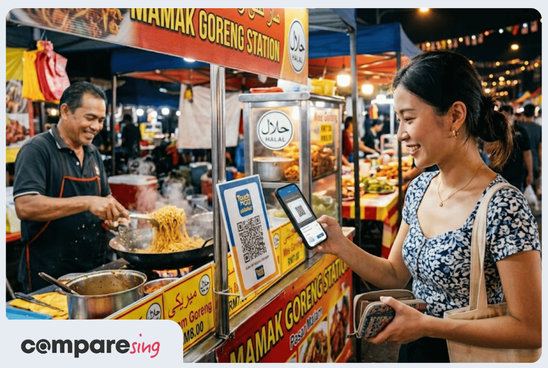
Touch ‘n Go (TNG) is one of the most convenient ways to make cashless payments in Malaysia. From tolls, parking, and public transport to shopping, QR payments, and food, the little blue icon is accepted almost everywhere, making it essential for anyone crossing the Causeway regularly.
The good news? You don’t need a Malaysian IC or bank account to get started! Both the physical Touch ‘n Go card and the TNG ewallet are open to foreigners, and registration just takes minutes.
This guide covers everything Singaporeans need to know about using Touch ‘n Go Singapore-side and across the border, including how to register, wallet limits and fees, setting up, making top-ups, and the best alternatives.
Touch ‘n Go at a Glance
| Feature | Details |
|---|---|
| Eligibility | Foreigners are welcome, including Singaporeans. No Malaysian NRIC or local number needed. |
| Registration | Via the TNG eWallet app with an eligible mobile number (+65 accepted); passport eKYC unlocks the Premium tier. |
| Accepted at | Tolls, QR code payments, parking, petrol, public transport, restaurants, retail, bills, tickets, and DuitNow QR merchants. |
| Wallet limits and tiers | Lite: RM200 (default) Premium: RM20,000 |
| Top-up methods | Malaysian online banking, DuitNow transfer, Visa/Mastercard (including foreign-issued cards), TNG reload PINs, Singtel Dash |
| Top-up fee | Free via Malaysian banks; up to 2.6% for foreign-issued cards; S$2 flat fee via Singtel Dash |
What is Touch ‘n Go?
Touch ‘n Go started life as Malaysia’s toll payment card, but has since evolved into an all-in-one superapp for everyday transactions, financial services, and transit. As the name suggests, simply tap to pay.
You can use TNG for tolls, public transport, petrol, bills, restaurants, retail, tickets, parking, money transfers, QR payments, and more. It’s the most widely accepted cashless payment method in Malaysia, and foreigners (including Singaporeans) can register with just a passport and mobile number, no Malaysian NRIC or local SIM required.
There are three formats: the physical TNG card, the TNG ewallet app, and the TNG visa card — a prepaid Visa linked to your eWallet balance that requires legal residence in Malaysia, making it impractical for most Singaporeans (hence we’ll focus on the more relevant formats).
Touch ‘n Go Card vs TNG eWallet: What’s the Difference?
The card and eWallet are separate products with separate balances; money in one doesn’t appear in the other, even after linking through PayDirect, which only changes which balance is charged at supported toll and parking terminals.
Touch ‘n Go Card
The Touch ‘n Go card is a contactless stored-value card you tap at toll booths, MRT/LRT gantries, bus readers, and parking barriers.
It works offline with no app needed, which is why it remains the default for highways. Standard cards are reloaded physically at counters and kiosks; the newer NFC-enabled card can be topped up through the app.
Touch ‘n Go eWallet
The TNG ewallet is a smartphone app for QR payments at shops, restaurants, and hawker stalls, plus online checkouts, bills, and transfers. Reloaded digitally via bank transfer, card, or reload PIN (a prepaid voucher code), it’s the easier entry point for Singaporeans since everything is managed from your phone.
Touch ‘n Go eWallet Limits & Tiers
The eWallet comes in two account sizes. Everyone who creates an account starts on Lite; upgrading to Premium requires eKYC (Know Your Customer) verification with your passport.
| Lite | Premium | |
|---|---|---|
| Maximum wallet balance | RM200 | RM20,000 |
| Verification | Basic sign-up (mobile number) | eKYC with passport/ID and selfie |
| Best for | Occasional day trips | Frequent travellers and bigger spends |
When should you consider Touch ‘n Go Premium eWallet? To be honest, premium is worth doing upfront: RM200 fills up quickly once you factor in petrol, meals, and shopping, and verification takes minutes.
Touch ‘n Go eWallet Convenience Fees
| Top-up method | Fee |
|---|---|
| DuitNow transfer | Free |
| Malaysian-issued debit card | Free |
| TNG reload PIN | No fee when credited as non-transferable balance; 1% if converted to transferable balance. |
| Malaysian-issued credit card | 1% |
| Non-Malaysian (foreign-issued) debit/credit card | Up to 2.6% of top-up amount |
| Singtel Dash | S$2 flat fee |
Crucial note for Singaporeans: topping up with a non-Malaysian debit or credit card incurs up to a 2.6% convenience fee — and this includes multi-currency cards like Revolut, Wise, YouTrip, and Trust.
Not to worry, there is a workaround! Simply top up via Singtel Dash as they only charge a flat S$2 fee (minimum top-up RM20), which is cheaper than 2.6% for larger amounts.
How to Set Up TNG eWallet (For Singaporeans)
- Download the TNG eWallet app from the App Store or Google Play.
- Register with your Singapore (+65) mobile number and verify via OTP.
- Set your 6-digit payment PIN.
- Complete eKYC — snap your passport and take a selfie — to upgrade to Premium (RM20,000 limit).
- Top up your balance (see below) and start paying.
When travelling in Malaysia, you will need mobile data for maps, transport, payment and more — see our guide to the Best eSIMs for Malaysia Travel!
How to Top Up Touch ‘n Go eWallet
Wondering how to top up Touch ‘n Go from Singapore? You can do so in a few taps:
- Open the TNG eWallet app and tap Reload, then eWallet Balance.
- Enter your amount. The minimum is RM20 for card reloads, while DuitNow Transfer can be used for smaller amounts starting from RM1.
- Choose a payment method: debit/credit card (foreign-issued cards work but incur the 2.6% fee), online banking/DuitNow (free, Malaysian bank account needed), or a TNG reload PIN bought at 7-Eleven, petrol stations, or other agents.
- Confirm and your Touch ‘n Go top up is credited instantly.
Alternatively, use Singtel Dash: link your TNG eWallet in the Dash app, enter the amount, and pay the flat S$2 fee. If you have the NFC-enabled TNG card, tap it against your phone and transfer value directly via the eWallet.
How to Pay with Touch ‘n Go eWallet
In-store: Tap Scan to scan the merchant’s DuitNow QR code, enter the amount if prompted, and confirm with your PIN. At larger retailers, tap Pay instead to show your barcode for the cashier to scan.
Online: Select Touch ‘n Go eWallet at checkout on Malaysian platforms like Shopee MY, Lazada MY, Grab, and food delivery apps, then approve in-app. The eWallet also handles bills, prepaid reloads, tickets, and transfers to other TNG users.
How to Link Touch ‘n Go Card to eWallet
Linking your Touch ‘n Go card to the eWallet means toll fares are deducted from your eWallet balance instead of the card — no more queuing at reload lanes.
- Open the TNG eWallet app and tap Toll.
- Choose TNG Card and add a new card.
- Enter your card’s 10-digit serial number and submit using your 6-digit PIN.
- Confirm and the card is now paired.
Once linked, tolls and PayDirect-enabled parking deduct straight from the eWallet, with every transaction logged in-app.
Best Alternatives to Touch ‘n Go
Touch ‘n Go isn’t always the cheapest option, especially given the 2.6% foreign card top-up fee.
Here are the best alternatives for cashless payments in Malaysia.
Best for Bank Transfers: DuitNow
DuitNow is Malaysia’s equivalent of PayNow, which enables instant transfers via mobile number or NRIC. Thanks to the PayNow-DuitNow linkage, Singaporeans can send money from their local bank app to a Malaysian mobile number in real time, no Malaysian account needed.
Participating Singapore banks include DBS/POSB, OCBC, UOB, and Maybank Singapore, transferring to most major Malaysian banks and eWallets.
The catch: daily transfer limits apply (typically around S$1,000, varying by bank), and the exchange rate carries a markup that’s generally higher than multi-currency cards — so it’s best for transfers, not everyday spending.
Best for Credit Card Rewards: Instarem amaze
Instarem amaze is a free Mastercard that links to up to five of your existing Singapore cards. Pay in ringgit, and amaze converts the transaction to SGD at a lower FX spread (up to 2.1%, versus the typical 3.25% credit card FX fee) — while you still earn your card’s rewards or cashback.
Most importantly, the amaze card converts eligible offline transactions into online, allowing you to earn credit card rewards for online spending.
With that said, here are some credit cards that can help you earn miles and cashback!
| Card | Maximum earn rate | Best for |
|---|---|---|
| Citi Rewards | 4 miles per S$1 on eligible online spend | Shopping and general online spend |
| OCBC Rewards | Up to 4 miles per S$1 on selected shopping categories | Department stores and retail |
| Maybank Family & Friends | Up to 8% cashback on five chosen categories | Groceries, dining, petrol, transport |
| Maybank XL | 4 miles per S$1 on dining, shopping, entertainment, and travel spend | Dining, department stores, movies, flights, and hotel bookings |
Curious to discover which credit card gives the most miles? Read our guide on the best miles credit cards.
Best for Everyday Spending and Cash Withdrawals: Revolut, Wise, YouTrip
Multi-currency cards let you hold several currencies and “lock in” ringgit when the rate is favourable, and can be among the lower-cost options to withdraw cash from Malaysian ATMs.
| Revolut (Standard) | Wise | YouTrip | |
|---|---|---|---|
| Conversion fees & weekend markup | Free within monthly fair-usage limit; ~1% markup on weekends | From ~0.26% per conversion; no weekend markup | No conversion fee; no weekend markup |
| Exchange rate used | Interbank rate | Mid-market rate | Wholesale Mastercard rate |
| Overseas ATM withdrawals | Free up to S$350/month, 2% fee after or S$1.49, whichever is higher ( third-party ATM fees may also apply) | First S$100 per month free,
1.75% on the amount above S$100 |
Free up to S$400/month, 2% fee after |
| Virtual cards allowed | Multiple, including single-use disposable cards | Up to 3 | 1 |
For a full breakdown, see our guide to the Best Multi-Currency Cards and Travel Cards.
Best 0% FX Cards: Trust Card, Mari Credit Card, Chocolate Finance
If you’d rather skip FX fees entirely while earning rewards, three Singapore cards charge zero foreign transaction fees.
| Card | Earn rates | Exchange rate used |
|---|---|---|
| Trust Credit Card | 0.5% cashback | Visa rate, 0% FX fee |
| Mari Credit Card | Flat cashback on all spend, including foreign currency | Network rate, 0% FX fee |
| Chocolate Finance Card | 1 Max Mile per S$1 on eligible spending for the first S$1,000 each month
0.4 Max Miles per S$1 thereafter |
Visa rate, 0% FX fee |
See our Trust Credit Card Review, Mari Credit Card Review, and Chocolate Finance Review for full details!
Conclusion
If you head across the Causeway even a few times a year, setting up Touch ‘n Go is a no-brainer.
The TNG eWallet takes minutes to register with just your passport and Singapore mobile number, and linking your TNG card via PayDirect allows supported toll and parking charges to be deducted from your eWallet, while the physical card maintains its own separate balance.
Just be smart about top-ups: the 2.6% fee on foreign-issued cards adds up, so reload via Singtel Dash or reload PINs where you can. For everyday retail spending, a multi-currency or 0% FX card will often beat the eWallet on exchange rates. Used together, they’ll keep your ringgit spending seamless and cheap.
Touch ‘n Go FAQs
Where can I buy a Touch ‘n Go Card in Singapore?
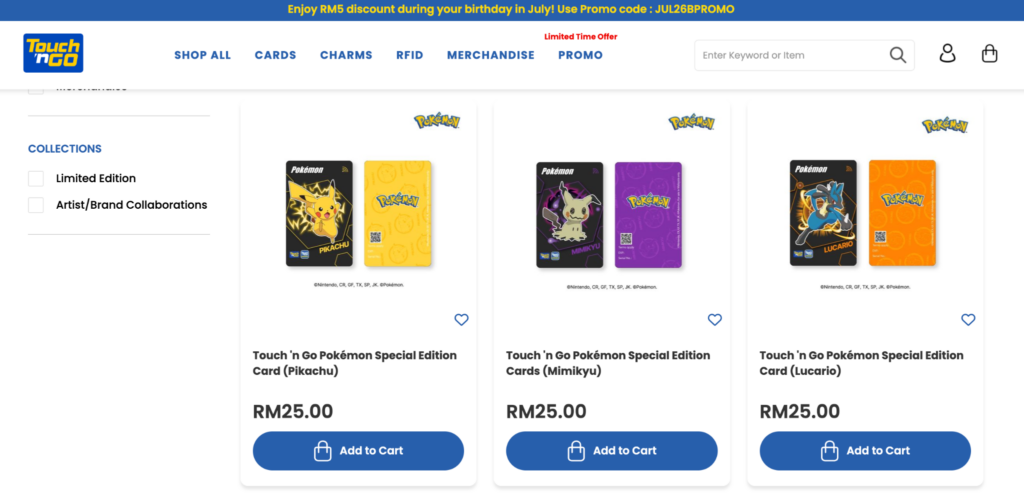
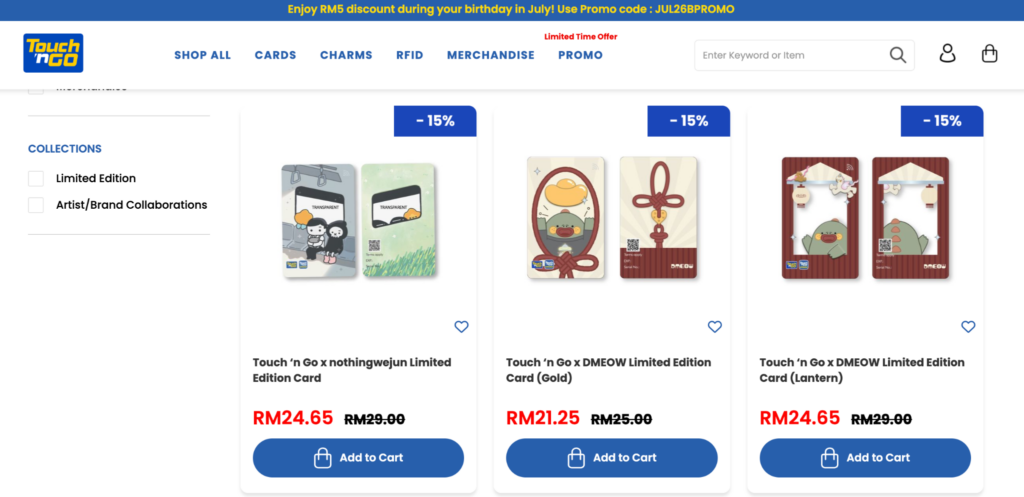
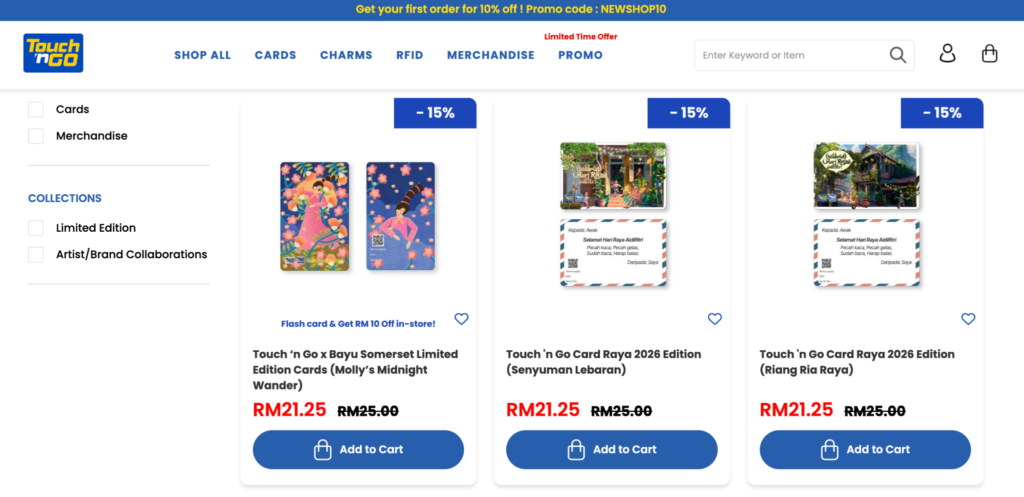
Image credit: Touch ‘n Go
Try e-commerce sites like Shopee and Lazada. In Malaysia, the card is widely available at convenience stores (7-Eleven, KK Mart, Watsons), airport kiosks, highway toll plazas, petrol stations, LRT/MRT stations, and the official online store.
Expect to pay RM10 to RM25 (limited edition designs), excluding credit.
Where can I top up my Touch ‘n Go card?
Reloads are free at official TNG reload points — TNG Hubs, self-service kiosks, TNG SPOTs, 99 Speedmart, Watsons, and selected petrol stations — while some agents, notably 7-Eleven, charge a small fee.
If you have the NFC-enabled card, you can top it up via the app; otherwise you’ll need a physical reload point in Malaysia. Find the full list here.
What’s the difference between the TNG card and eWallet?
The card is a physical tap-to-pay device for tolls, transit, and parking; the eWallet is an app for QR payments, online checkouts, bills, and transfers. They hold separate balances.
Can I use Touch ‘n Go for parking?
Yes. Link your card to the eWallet via PayDirect and parking fees at supported car parks deduct from your eWallet balance — no manual card top-ups needed.
Can I use Touch ‘n Go on buses and LRT/MRT?
Yes, the TNG card is accepted on buses and LRT/MRT/monorail networks across Malaysia — simply tap in and out.
Can I use Touch ‘n Go without a Malaysian phone number?
Yes. The eWallet accepts foreign numbers, including +65 numbers, and foreigners verify with a passport.
Is Touch ‘n Go better than DuitNow?
They serve different purposes. TNG is a payment ecosystem, best for tolls, transit, parking, and QR payments on the ground. DuitNow is a transfer network, best for sending money to Malaysian bank accounts or eWallets via PayNow. Most regular visitors end up using both.