Key Takeaways
- Comparing lab-grown diamonds vs natural mined diamonds isn’t a real-versus-fake debate: both have essentially the same chemical, physical and optical properties.
- The cost of lab-grown diamonds vs natural stones is where they split: lab-grown diamonds generally cost substantially less, though savings vary by specifications, grading report and retailer.
- Natural mined diamonds resell more easily, but both can fetch far less than you paid, so neither is a dependable investment.
- The 1ct price gap could help cover a wedding banquet deposit or home costs.
If you’re comparing engagement ring prices from Singapore jewellers, keep this in mind: a one-carat (1ct) natural diamond and a similar-grade lab-grown one are, for practical purposes, the same material.
What differs is the receipt.
Choosing lab-grown can free up budget for other costs, like the loose furnishings that bank renovation loans generally exclude. This mined diamonds vs lab-grown diamonds cost guide will not tell you which stone type is morally correct. Instead, we’ll show you what you are actually paying for, so the money lands where you want it to.
What’s a Lab-Grown Diamond?
A lab-grown diamond grows from a small diamond seed over a few weeks, through High Pressure High Temperature (HPHT) or Chemical Vapour Deposition (CVD).
HPHT mimics the heat and pressure that form natural diamonds; CVD builds the crystal layer by layer. Reporting depends on the laboratory: the International Gemological Institute (IGI) documents the 4Cs, while the Gemological Institute of America (GIA) has used “Premium” and “Standard” quality assessments for colourless to near-colourless lab-grown diamonds since 1 October 2025.
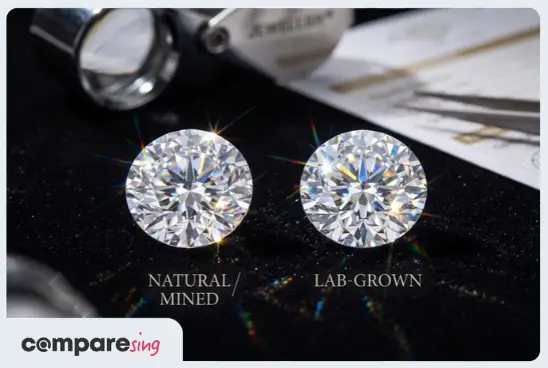
So “lab-grown diamonds vs real diamonds” can be misleading: these lab-grown stones are diamonds with essentially the same chemical, physical, and optical properties as natural ones.
Natural diamonds commonly contain trace nitrogen (and boron, which is much rarer), and lab-grown stones can show diagnostic growth structures, but when matched for cut, colour and clarity, the two generally look alike to the unaided eye.
So can a jeweller tell if a diamond is lab-grown? Not reliably with the naked eye; identification may require specialist testing by a suitably equipped jeweller or gemmological laboratory.
Which Is More Expensive: Lab-Grown or Natural Diamonds?
The table shows the lowest and highest prices for available round brilliant stones on Michael Trio’s Singapore website on 19 October 2026, all D colour, VS1 clarity, Excellent cut, polish and symmetry, with no fluorescence (natural: GIA-graded; lab-grown: IGI-graded). Loose-stone prices exclude the 9% GST added at checkout.
Treat them as one retailer’s examples, not a standardised market index.
| Carat (round brilliant) | Lab-grown diamond in Singapore | Natural diamond |
| 0.50–0.54ct | S$445–S$831 | S$1,580–S$2,096 |
| 1.00–1.04ct | S$727–S$1,126 | S$6,948–S$8,759 |
| 1.50–1.54ct | S$1,155–S$1,666 | S$15,021–S$18,222 |
| 2.00–2.04ct | S$1,674–S$2,475 | S$31,778–S$40,212 |
Comparing each row’s cheapest stones, lab-grown is about 72% to 95% cheaper, with the widest gaps at larger sizes.
In May 2025, De Beers reported that wholesale prices for lab-grown diamonds used in jewellery had dropped about 90% since 2018. Natural-diamond prices have also weakened, though movements vary by stone size, quality and market.
Two tax points affect the diamond ring price Singapore shoppers actually pay:
- First, 9% GST applies, as diamond jewellery doesn’t qualify for the investment precious metals exemption. GST-registered jewellers’ prices generally include it, but some online listings, like Michael Trio’s above, add it at checkout.
- Second, buying overseas doesn’t necessarily avoid it: eligible travellers get GST relief on up to S$500 of purchases after at least 48 hours abroad, or S$100 after a shorter trip, and pay GST on the excess.
How Four Words Helped Sell Diamond Rings
Founded in 1888, De Beers spent a century controlling how much of the world’s supply reached the market. Its slogan “A Diamond Is Forever”, created in 1947, arguably helped lift the share of American brides with a diamond ring from roughly 10% in 1939 to about 80% by 1990.
The “two months’ salary” rule is advertising copy too: doubling MOM’s 2025 median gross monthly income for full-time employed residents (S$5,775, including employer CPF and one-twelfth of annual bonuses) gives an “expected” S$11,550, which is not a budget recommendation.
Then the darker part. The Kimberley Process Certification Scheme came into force in 2003 to restrict trade in rough diamonds that finance rebel conflicts, or conflict diamonds. Global Witness, which helped establish it, quit in 2011, saying the scheme had failed.
Natural Diamonds vs Lab-Grown: Pros and Cons
| Diamond Type | Pros | Cons |
| Lab-grown diamonds | More size and higher grades for a given budget; avoids the conflict-financing risks specific to diamond mining | Weak secondary market; prices far below earlier levels despite some wholesale stabilisation in Q3 2026; substantial energy use, with a carbon footprint that depends on electricity sources, production efficiency and the wider supply chain |
| Natural/Mined diamonds | Finite supply; a more established resale market; royalties fund national budgets in Botswana and Namibia; cultural and family weight | Several times the price for comparable specs; typically resells well below retail; provenance remains hard to audit |
Lab-Grown Diamonds vs Natural Diamonds: Which Has a Better Resale Value?
Natural diamonds, but that doesn’t make them a good investment!
There is no universal resale percentage. Natural diamonds have more established resale channels, though returns depend on the stone, price paid, buyer and selling costs; lab-grown stones have fewer resale options, and some established buyers won’t accept them.
Some sobering maths, using hypothetical diamond-only figures: if a S$10,000 natural diamond resells for S$4,000 and a S$1,200 lab-grown one fetches nothing, the natural diamond loses S$6,000, five times the lab-grown stone’s S$1,200 loss. These are illustrative assumptions, not predictions.
More useful is what lab-grown frees upfront: S$8,800 in this example, which could earn interest in one of the Best High Interest Savings Accounts In Singapore, subject to rates and qualifying conditions, or reduce your renovation borrowing.
Pay cash first, card second, loan last. Jewellers usually fall under MCC 5944, which not every card rewards (see our MCC Code Singapore Guide). One of the Best Credit Cards For Miles could help fund the honeymoon.
As with the MacBook Price Hike, buy what fits the budget, not what the marketing points at.
If the ring itself needs financing, the budget is the problem, not the stone! For wider wedding costs, see Wedding Loans: How To Budget For Your Big Day, then our Personal Loan comparison and How To Get The Lowest Interest Personal Loans In Singapore.
Conclusion
We won’t tell you which stone to buy—that’s personal. Lab-grown diamonds and mined stones share essentially the same core material properties; how a ring looks and wears depends on the individual stone’s quality plus the setting, metal and workmanship.
Our take: set your combined wedding-and-home budget, decide the ring’s share before anyone shows you a tray of sparkly engagement rings in Singapore, then choose the stone that fits.
That’s our answer to how much to spend on an engagement ring in Singapore: a share of a budget you’ve set, not a multiple of your salary.
A few related reads for your perusal:
- HDB Loan vs Bank Loan: The Key Differences: How your loan choice affects your down payment, CPF usage and refinancing options.
- The 50/30/20 Budgeting Rule: How to split take-home pay between needs, wants and savings.
- 8 HDB Home Renovation Tips for First-time Homeowners: Lessons on fittings, furniture and keeping costs in check.
FAQs
Are lab-grown diamonds real diamonds?
Yes. They are essentially the same as natural diamonds in chemical composition, crystal structure and optical and physical properties, differing mainly in origin.
Can a jeweller tell the difference between a lab-grown and a natural diamond?
Not reliably by appearance alone. A jeweller may check a laser inscription under magnification or use specialist testing; the Gemological Institute of America and International Gemological Institute identify lab-grown origin on their reports and inscribe lab-grown stones accordingly. Natural diamonds are not all laser-inscribed.
Do lab-grown diamonds hold value?
Poorly: resale options are limited, and some established buyers refuse lab-grown stones. Natural stones resell more easily, but usually well below what you paid.
What are the disadvantages of lab-grown diamonds?
A thin secondary market and substantial energy use, with a carbon footprint that depends on electricity sources, production efficiency and the wider supply chain. Prices have fallen sharply over the longer term, though analyst Edahn Golan’s Q3 2026 data showed wholesale prices for 1–3ct round lab-grown diamonds up about 2% on the quarter but 9% below a year earlier.
How much should I spend on an engagement ring in Singapore?
Our take is whatever share of your combined wedding-and-home budget you can comfortably allocate, not two months’ salary, a rule that came from advertising.
Is moissanite a better buy?
Moissanite is a different material from both lab-grown and natural diamonds. It is usually cheaper than a natural diamond of similar size, with double refraction and stronger “fire” (colour dispersion), both worth seeing in person.
CompareSing is not a licensed financial adviser. This article is for general information only and is not financial advice.